How to Buy Telegram Group Members Without Getting the Group Restricted
The delivery patterns that actually trigger Telegram's spam systems - join velocity, account provenance, session origin - plus a pacing schedule that keeps your group clean.
You have already decided to pay for members. The open question is narrower and more expensive to get wrong: which delivery patterns put the group at risk, and which ones pass without anyone noticing.
The account that gets limited is usually not yours. What you feel instead is a group whose invite link stops converting, a members-only bot that starts throwing errors, and - in the worst case - a public username that quietly stops resolving.
Telegram does not punish you for buying. It punishes patterns.
There is no billing signal. Telegram cannot see your invoice, your crypto payment, or the Fiverr gig you used. What its systems can see is behavioural, and it falls into four buckets:
- The rate of joins compared to that group's own history.
- The accounts joining: registration age, phone provenance, how many groups they already sit in, whether they carry prior spam reports.
- The sessions those accounts run from: IP ranges, data centre assignment, client fingerprint, how many accounts share one exit node.
- What happens after the join: zero message reads, mass exits inside 48 hours, and reports filed by real members who noticed.
Enforcement then lands in three separate places, and most vendors deliberately blur them so a bad outcome looks like your fault.
| What gets hit | Typical trigger | What it feels like | Recovery |
|---|---|---|---|
| The adding account | Too many channels.inviteToChannel calls, too many privacy rejections in a row |
PEER_FLOOD, then a spam limit on that account |
Appeal via @SpamBot; often days, sometimes never |
| The delivered members | Accounts flagged as bulk-registered or reused | Members vanish 3-30 days later | None - they are gone |
| The group itself | User reports, plus a join curve that looks nothing like organic | Public username stripped, link dead, "reported for spam" banner | Support appeal, slow, low success rate |
Most buyers assume the third row is the common outcome. It isn't. The common outcome is row two - you pay for 10,000, you keep 6,200, and the vendor's terms quietly define delivery as "added", not "retained". Row three happens when the delivery is fast, the accounts are visibly synthetic, and real people in the group start reporting.
The three delivery signals that decide the outcome
Join velocity, measured against your own baseline
There is no published threshold. Anyone quoting you an exact "safe number of joins per day straight from Telegram" is inventing it. What you can reason about is the shape of the curve relative to the group's own history, because that is the only comparison an anomaly detector has cheap access to.
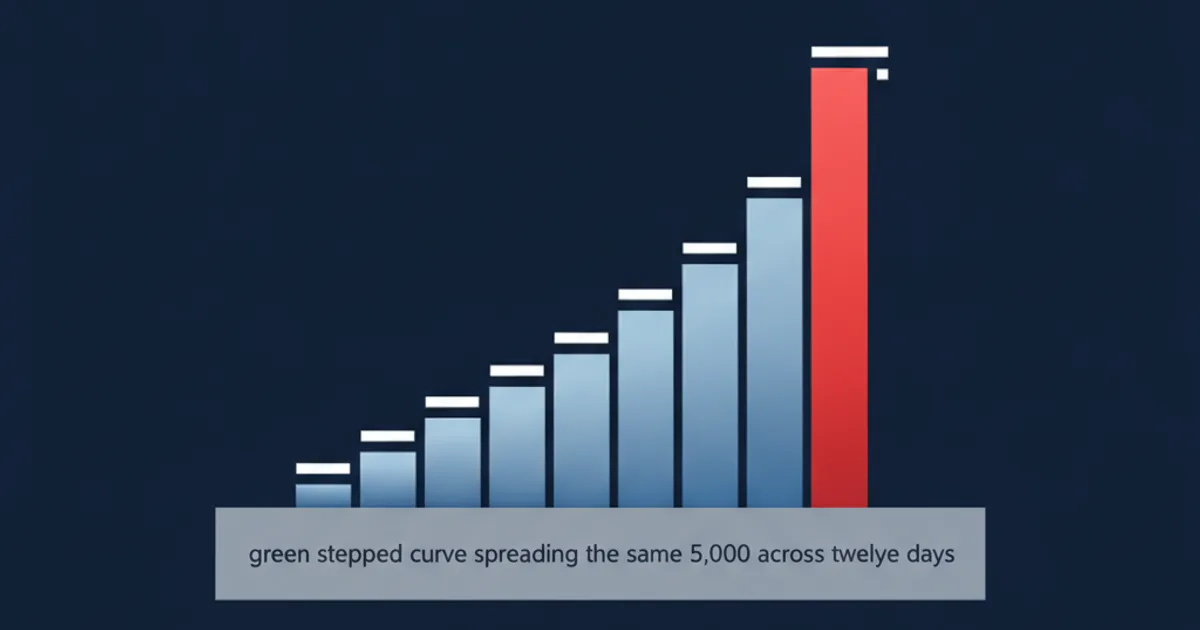
A group sitting at 400 members that gains 5,000 in ninety minutes has changed by a factor of thirteen with no corresponding change in message volume. A group that adds 300-600 a day for two weeks looks like a group that got mentioned somewhere. Same total, entirely different signature.
The working rule we use: daily intake capped at roughly 10% of current member count, with a hard ceiling in the first few days regardless of percentage. Small groups need the ceiling because 10% of 200 is meaningless.
Account provenance
This is where the price differences between vendors actually come from. An account registered eighteen months ago on a real SIM, with a profile photo, a username and membership in a dozen unrelated groups, costs several dollars to source. An account registered this morning on a recycled virtual number, no photo, no username, already sitting in 480 groups, costs cents.
That second account is also close to useless. Telegram caps how many groups and channels a single account can belong to - 500 on a free account, 1,000 on Premium - so a heavily-recycled account is stuck at its ceiling: its own joins come back CHANNELS_TOO_MUCH, and anyone trying to add it gets USER_CHANNELS_TOO_MUCH. Vendors at the bottom of the market are burning through accounts that are already at their ceiling, which is why their delivery "completes" but your member count barely moves.
Session origin
Two hundred accounts joining from four IP addresses inside one hosting provider's range is a pattern that survives no scrutiny at all. Telegram also assigns each account to a data centre based on the registering phone number's region, so a batch of accounts with Indonesian numbers all suddenly transacting through a German VPS is a second, independent correlation.
This is the one signal you cannot audit from outside. You can only ask, and judge the answer - a vendor who talks fluently about DC assignment and residential proxy pools has thought about it; one who says "we use safe methods" has not.
Direct adds versus invite-link joins
These are different API operations with different failure modes, and the distinction changes what you should be willing to pay.
A direct add requires an account that is already a member of your group and holds the Add Users permission (admins always have it; regular members only if you granted it in group permissions). It then fails outright against anyone who set Settings → Privacy and Security → Groups & Channels to My Contacts - the API returns USER_PRIVACY_RESTRICTED, and a run of those errors is itself a strong spam signal against the adding account.
An invite-link join is initiated by the joining account. It cannot be blocked by privacy settings, it produces a cleaner event stream, and it works with Telegram's own approval features - you can generate a link that requires admin approval, which gives you a queue you control instead of a flood you don't.
| Direct add | Invite-link join | |
|---|---|---|
| Blocked by target's privacy setting | Yes | No |
| Burns the operator account | Heavily | Barely |
| Appears in the group as | "X added Y" | "Y joined the group" |
| Rate-limitable by you | Only by pacing the script | Yes, via join requests |
| Works for a private group | Yes | Yes, with the link |
Prefer link-driven delivery with join requests enabled when the group is sensitive. It is slower and it costs more, because the vendor now has to persuade accounts to act rather than push them.
A pacing schedule that holds up
For a group with existing activity, spread delivery across a window rather than a day. The ladder below is what we run by default; it is conservative on purpose, and it exists because the cost of a stalled group is far higher than the cost of waiting a week.
| Phase | Days | Daily intake | Notes |
|---|---|---|---|
| Warm-up | 1-2 | ≤ 5% of current size, max 200 | Confirms the group accepts joins cleanly |
| Ramp | 3-7 | ≤ 10% of current size, max 800/day | Post daily during this phase |
| Cruise | 8+ | ≤ 10% of running total, max 1,500/day | Compounding, so this accelerates on its own |
| Hold | After target | 0 for 72h | Watch the leave rate before ordering more |
Note what the "cruise" row does mathematically: because the cap is a percentage of the running total, the absolute daily number climbs by itself. That is the whole point - it mimics the shape of a group that is genuinely catching on.
Worked example: 400 members to 10,400
A trading-signals group, 400 members, roughly 40 messages a day. Target: 10,000 more.
Days 1-2 at 5%: 20, then 21. Trivial, but it proves the pipe works. Days 3-7 at 10%: 44, 48, 53, 58, 64 - total 267 by day 7, sitting at 708. From day 8, 10% compounding: 71, 78, 86, 94, 104, 114, 126, 138, 152, 167, 184, 202, 222, 245, 269, 296, 326, 358, 394, 434, 477, 525…
Compounding at 10% doubles roughly every 7.3 days, so the group crosses 5,000 around day 29 and 10,400 around day 37 - and by then the daily cap has risen past 900, still nowhere near the 1,500 ceiling. Just under six weeks, no day where the group grew more than a tenth of itself.
Now price it. Ten thousand members clears the volume step at 10,000, so the rate is $56 per 1,000 and the order is $560. Dumping the same 10,000 in one evening costs exactly the same $560 and buys a materially worse asset. The pacing is free. Skipping it is what's expensive.
If the six weeks is genuinely unacceptable, the honest compromise is a shorter window with a smaller number - 4,000 over two weeks beats 10,000 over two days every time.
Where sourcing actually matters
The members have to come from somewhere, and that choice determines whether the group is worth having. Delivery from named source groups - you list the public groups where your audience already sits, up to ten of them, and members are drawn from those - produces a group whose members share a topic with yours. That is how TeleReach runs orders: you name the source groups, or you take our US online-shopper audience if you are selling deal content and don't have obvious sources to point at. $60 per 1,000, dropping to $52 per 1,000 at 50,000, paced across a schedule you agree up front rather than dumped in an evening.
What usually goes wrong
Ordering "members" for a channel. Channels take subscribers, not members, and their subscriber lists are not visible the way a public group's member list is. A vendor who takes the order without flagging the difference is not paying attention to your account.
Buying the day before a launch. The fast delivery you need for a deadline is exactly the pattern that gets flagged. Order four weeks out.
Switching on Aggressive Anti-Spam mid-delivery. Available in groups over 100 members, and it will start removing exactly the accounts you just paid for. Decide before, not during.
Locking down permissions so hard the group looks dead. New members who cannot post, cannot see history, and get greeted by a bot wall will leave inside a day, and mass exits are their own signal.
Never posting. Ten thousand members against four messages a week is the single most reportable configuration on Telegram. Delivery pacing buys you nothing if the content side is empty.
Accepting "we'll refill drops" without a definition. Refill of what, measured when, against which snapshot? Get the number and the date in writing before you pay.
Next step
Pull your current member count and your last 30 days of joins. That gives you the baseline every number above is relative to. Then decide your window before you decide your quantity - the schedule sets the size, not the other way round. When you have both, place the order with your source groups named and hold the pacing.
Need the members to go with the plan
Everything above works better with an audience already in the room. TeleReach adds members to your group from the groups your buyers already sit in, priced at $60.00 per 1,000 members, delivered gradually and tracked live while it runs. No subscription, and whatever is not delivered comes back to your wallet.